This is a demo store. No orders will be fulfilled.


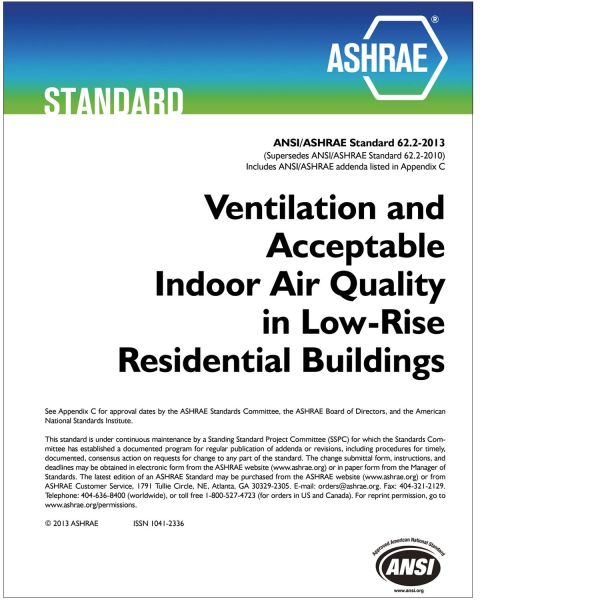
ANSI/ASHRAE 62.2-2013 Ventilation and Acceptable Indoor Air Quality in Low-Rise Residential Bldgs (PDF Download)
Item #: 8950P815
Price: $58.00
Member Price: $58.00
Member Savings: $0.00
$58.00
The PDF/Redline Download option contains PDF files of both the I-Code and a Redline version of the I-Code which shows changes from the previous edition marked in the color red. With the Redline you can see what has been changed from the previous edition. This option is a searchable PDF download that requires a PDF Reader. It is mobile compatible with mobile tablets and smart phones that support the PDF format. The PDF Download is licensed per individual, who may place the file on up to four electronic devices for their personal use. Distribution of the PDF is not permitted. For a volume license the PDF is licensed to the person to which it is assigned. Use on a local area network or other network is not permitted.
Increased Mechanical Ventilation Rates and More in Standard 62.2-2013
For the 2013 edition of ANSI/ASHRAE Standard 62.2, mechanical ventilation rates have been increased to reflect the elimination of the default assumption of a leakage rate of 2 cfm per 100 ft². Other significant changes were made regarding climate limitations on pressurization and depressurization, carbon monoxide alarms, and calculations and weather data for estimating annual leakage. In total, this 2013 edition incorporates the contents of 17 addenda into the 2010 edition.
Standard 62.2 defines the roles of and minimum requirements for mechanical and natural ventilation systems and the building envelope intended to provide acceptable indoor air quality in low-rise residential buildings. As in the previous editions of this standard, there are three primary sets of requirements and a number of secondary ones. The three primary sets involve whole-building ventilation, local demand-controlled exhaust, and source control. The secondary requirements focus on properties of specific items needed to achieve the main objectives of the standard. Standard 62.2 applies to spaces intended for human occupancy within single-family houses and multi-family structures of three stories or fewer above grade, including manufactured and modular houses. This standard does not apply to transient housing such as hotels, motels, nursing homes, dormitories, or jails.
The standard considers chemical, physical, and biological contaminants that can affect air quality. It does not address thermal comfort requirements, specific pollutant concentration levels, or certain potential pollutant sources such as unvented combustion space heaters and contamination from outdoor sources or from episodic occupant-controlled events such as painting, smoking, cleaning, or other high-polluting events.
| Description: Links | |
|---|---|
| Description: | Increased Mechanical Ventilation Rates and More in Standard 62.2-2013 For the 2013 edition of ANSI/ASHRAE Standard 62.2, mechanical ventilation rates have been increased to reflect the elimination of the default assumption of a leakage rate of 2 cfm per 100 ft². Other significant changes were made regarding climate limitations on pressurization and depressurization, carbon monoxide alarms, and calculations and weather data for estimating annual leakage. In total, this 2013 edition incorporates the contents of 17 addenda into the 2010 edition. Standard 62.2 defines the roles of and minimum requirements for mechanical and natural ventilation systems and the building envelope intended to provide acceptable indoor air quality in low-rise residential buildings. As in the previous editions of this standard, there are three primary sets of requirements and a number of secondary ones. The three primary sets involve whole-building ventilation, local demand-controlled exhaust, and source control. The secondary requirements focus on properties of specific items needed to achieve the main objectives of the standard. Standard 62.2 applies to spaces intended for human occupancy within single-family houses and multi-family structures of three stories or fewer above grade, including manufactured and modular houses. This standard does not apply to transient housing such as hotels, motels, nursing homes, dormitories, or jails. The standard considers chemical, physical, and biological contaminants that can affect air quality. It does not address thermal comfort requirements, specific pollutant concentration levels, or certain potential pollutant sources such as unvented combustion space heaters and contamination from outdoor sources or from episodic occupant-controlled events such as painting, smoking, cleaning, or other high-polluting events. |
| Pages | 50 |
| Code Year | - Other - |
| Publisher | ASHRAE |
| Language | English |