This is a demo store. No orders will be fulfilled.


ASTM A416/A416M—12a Standard Specification for Steel Strand, Uncoated Seven-wire for Prestressed Concrete (PDF Download)
Item #: 8959P594
Price: $58.00
Member Price: $58.00
Member Savings: $0.00
$58.00
The PDF/Redline Download option contains PDF files of both the I-Code and a Redline version of the I-Code which shows changes from the previous edition marked in the color red. With the Redline you can see what has been changed from the previous edition. This option is a searchable PDF download that requires a PDF Reader. It is mobile compatible with mobile tablets and smart phones that support the PDF format. The PDF Download is licensed per individual, who may place the file on up to four electronic devices for their personal use. Distribution of the PDF is not permitted. For a volume license the PDF is licensed to the person to which it is assigned. Use on a local area network or other network is not permitted.
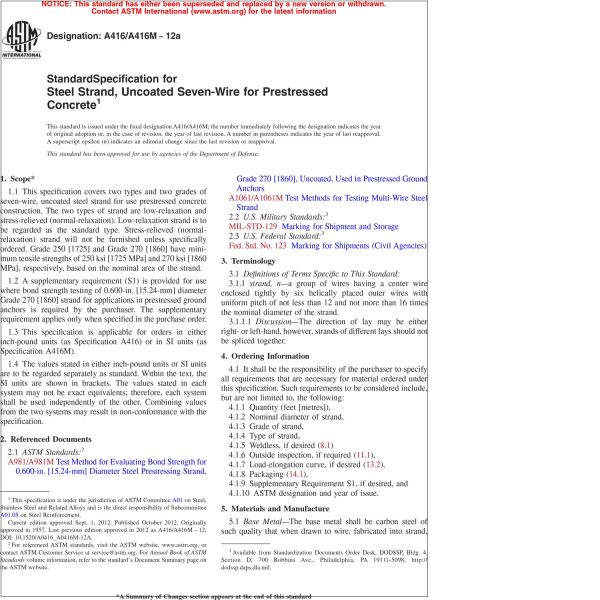
1.1 This specification covers two types and two grades of seven-wire, uncoated steel strand for use prestressed concrete construction. The two types of strand are low-relaxation and stress-relieved (normal-relaxation). Low-relaxation strand is to be regarded as the standard type. Stress-relieved (normal-relaxation) strand will not be furnished unless specifically ordered. Grade 250 [1725] and Grade 270 [1860] have minimum tensile strengths of 250 ksi [1725 MPa] and 270 ksi [1860 MPa], respectively, based on the nominal area of the strand.
1.2 A supplementary requirement (S1) is provided for use where bond strength testing of 0.600-in. [15.24-mm] diameter Grade 270 [1860] strand for applications in prestressed ground anchors is required by the purchaser. The supplementary requirement applies only when specified in the purchase order.
1.3 This specification is applicable for orders in either inch-pound units (as Specification A416) or in SI units (as Specification A416M).
1.4 The values stated in either inch-pound units or SI units are to be regarded separately as standard. Within the text, the SI units are shown in brackets. The values stated in each system may not be exact equivalents; therefore, each system shall be used independently of the other. Combining values from the two systems may result in non-conformance with the specification.
This standard is referenced in the 2015 International Building Code®.