This is a demo store. No orders will be fulfilled.


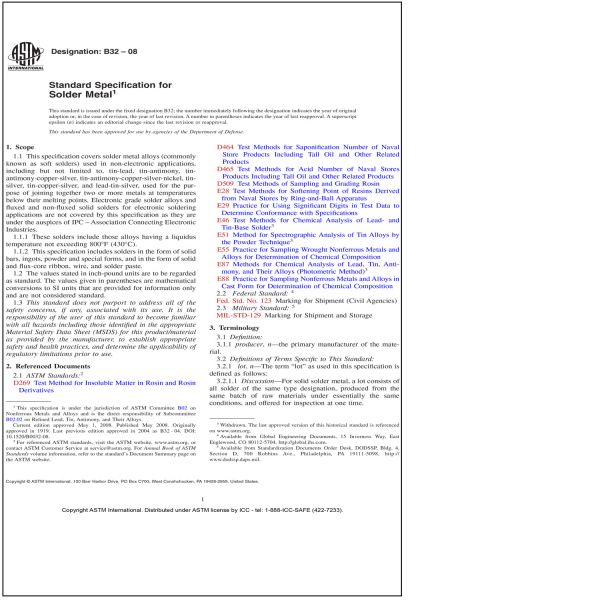
ASTM B 32—08 Specification for Solder Metal (PDF Download)
Item #: 8959P144
Price: $48.00
Member Price: $48.00
Member Savings: $0.00
$48.00
The PDF/Redline Download option contains PDF files of both the I-Code and a Redline version of the I-Code which shows changes from the previous edition marked in the color red. With the Redline you can see what has been changed from the previous edition. This option is a searchable PDF download that requires a PDF Reader. It is mobile compatible with mobile tablets and smart phones that support the PDF format. The PDF Download is licensed per individual, who may place the file on up to four electronic devices for their personal use. Distribution of the PDF is not permitted. For a volume license the PDF is licensed to the person to which it is assigned. Use on a local area network or other network is not permitted.
This specification covers solder metal alloys (also known as soft solders) used in non-electronic applications, including but not limited to, tin-lead, tin-antimony, tin-antimony-copper-silver, tin-antimony-copper-silver-nickel, tin-silver, tin-copper-silver, and lead-tin-silver, used for the purpose of joining together two or more metals at temperatures below their melting points. Included here are solders in the form of solid bars, ingots, powder and special forms, and in the form of solid and flux-core ribbons, wires, and solder pastes. Electronic grade solder alloys and fluxed and non-fluxed solid solders for electronic soldering applications are not taken into account here. Solder alloys shall adhere to chemical composition requirements specified for the following flux types: Types R, RMA, and RA, which are composed of Grade WW or WG gum rosin; Type OA, which is composed of water-soluble organic materials; Type OS, which is composed of water-insoluble organic materials; and Type IS, which is composed of inorganic saltsor acids. Solders shall also meet physical property requirements such as paste texture, powder mesh size, viscosity, solder pool, and dryness, and pass performance requirements such as chlorides and bromides test, copper mirror test, and visual inspection. Other properties to which the alloys should conform to are dimensions and unit weights, spread factor, and resistivity of water extract.
This standard is referenced in the 2012 International Mechanical Code®, International Plumbing Code®, International Private Sewage Disposal Code®, and International Residential Code®..
| Description: | This specification covers solder metal alloys (also known as soft solders) used in non-electronic applications, including but not limited to, tin-lead, tin-antimony, tin-antimony-copper-silver, tin-antimony-copper-silver-nickel, tin-silver, tin-copper-silver, and lead-tin-silver, used for the purpose of joining together two or more metals at temperatures below their melting points. Included here are solders in the form of solid bars, ingots, powder and special forms, and in the form of solid and flux-core ribbons, wires, and solder pastes. Electronic grade solder alloys and fluxed and non-fluxed solid solders for electronic soldering applications are not taken into account here. Solder alloys shall adhere to chemical composition requirements specified for the following flux types: Types R, RMA, and RA, which are composed of Grade WW or WG gum rosin; Type OA, which is composed of water-soluble organic materials; Type OS, which is composed of water-insoluble organic materials; and Type IS, which is composed of inorganic saltsor acids. Solders shall also meet physical property requirements such as paste texture, powder mesh size, viscosity, solder pool, and dryness, and pass performance requirements such as chlorides and bromides test, copper mirror test, and visual inspection. Other properties to which the alloys should conform to are dimensions and unit weights, spread factor, and resistivity of water extract. This standard is referenced in the 2012 International Mechanical Code®, International Plumbing Code®, International Private Sewage Disposal Code®, and International Residential Code®.. |
|---|---|
| Pages | 9 |
| Code Year | 2012 |
| Publisher | ASTM International |
| Language | English |