This is a demo store. No orders will be fulfilled.


ASTM C 1386—07 Specification for Precast Autoclaved Aerated Concrete (AAC) Wall Construction Units (PDF Download)
Item #: 8959P297
Price: $42.00
Member Price: $42.00
Member Savings: $0.00
$42.00
The PDF/Redline Download option contains PDF files of both the I-Code and a Redline version of the I-Code which shows changes from the previous edition marked in the color red. With the Redline you can see what has been changed from the previous edition. This option is a searchable PDF download that requires a PDF Reader. It is mobile compatible with mobile tablets and smart phones that support the PDF format. The PDF Download is licensed per individual, who may place the file on up to four electronic devices for their personal use. Distribution of the PDF is not permitted. For a volume license the PDF is licensed to the person to which it is assigned. Use on a local area network or other network is not permitted.
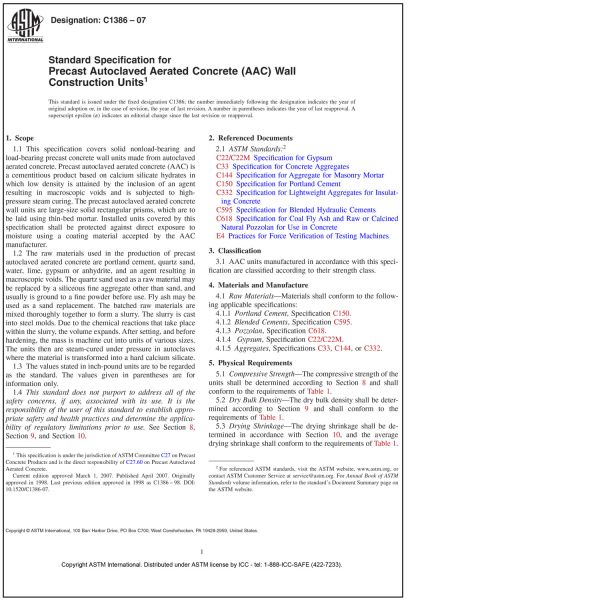
This specification covers solid nonload-bearing and load-bearing precast concrete wall units made from autoclaved aerated concrete. Precast autoclaved aerated concrete (AAC) is a cementitious product based on calcium silicate hydrates in which low density is attained by the inclusion of an agent resulting in macroscopic voids and is subjected to high-pressure steam curing. The precast autoclaved aerated concrete wall units are large-size solid rectangular prisms, which are to be laid using thin-bed mortar. Installed units shall be protected against direct exposure to moisture using a coating material. The raw materials used in the production of precast autoclaved aerated concrete are portland cement, quartz sand, water, lime, gypsum or anhydrite, and an agent resulting in macroscopic voids. The quartz sand used as a raw material may be replaced by a siliceous fine aggregate other than sand, and usually is ground to a fine powder before use. Fly ash may be used as a sand replacement. The batched raw materials are mixed thoroughly together to form a slurry. The slurry is cast into steel molds. Due to the chemical reactions that take place within the slurry, the volume expands. After setting, and before hardening, the mass is machine cut into units of various sizes. The units then are steam-cured under pressure in autoclaves where the material is transformed into a hard calcium silicate. The units shall be subjected to the following tests: compressive strength test, moisture content test, bulk density test, and shrinkage test.
This standard is referenced in the 2012 International Building Code®.
| Description: | This specification covers solid nonload-bearing and load-bearing precast concrete wall units made from autoclaved aerated concrete. Precast autoclaved aerated concrete (AAC) is a cementitious product based on calcium silicate hydrates in which low density is attained by the inclusion of an agent resulting in macroscopic voids and is subjected to high-pressure steam curing. The precast autoclaved aerated concrete wall units are large-size solid rectangular prisms, which are to be laid using thin-bed mortar. Installed units shall be protected against direct exposure to moisture using a coating material. The raw materials used in the production of precast autoclaved aerated concrete are portland cement, quartz sand, water, lime, gypsum or anhydrite, and an agent resulting in macroscopic voids. The quartz sand used as a raw material may be replaced by a siliceous fine aggregate other than sand, and usually is ground to a fine powder before use. Fly ash may be used as a sand replacement. The batched raw materials are mixed thoroughly together to form a slurry. The slurry is cast into steel molds. Due to the chemical reactions that take place within the slurry, the volume expands. After setting, and before hardening, the mass is machine cut into units of various sizes. The units then are steam-cured under pressure in autoclaves where the material is transformed into a hard calcium silicate. The units shall be subjected to the following tests: compressive strength test, moisture content test, bulk density test, and shrinkage test. This standard is referenced in the 2012 International Building Code®. |
|---|---|
| Pages | 4 |
| Code Year | 2012 |
| Publisher | ASTM International |
| Language | English |