This is a demo store. No orders will be fulfilled.


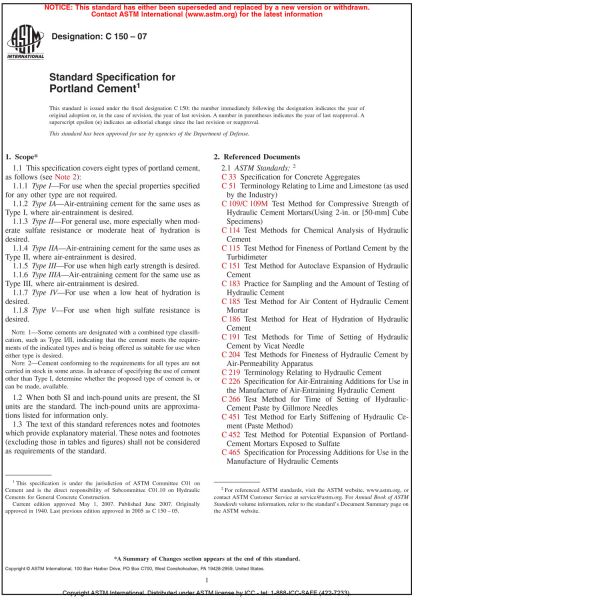
ASTM C 150—07 Specification for Portland Cement (PDF Download)
Item #: 8959P194
Price: $58.00
Member Price: $58.00
Member Savings: $0.00
$58.00
The PDF/Redline Download option contains PDF files of both the I-Code and a Redline version of the I-Code which shows changes from the previous edition marked in the color red. With the Redline you can see what has been changed from the previous edition. This option is a searchable PDF download that requires a PDF Reader. It is mobile compatible with mobile tablets and smart phones that support the PDF format. The PDF Download is licensed per individual, who may place the file on up to four electronic devices for their personal use. Distribution of the PDF is not permitted. For a volume license the PDF is licensed to the person to which it is assigned. Use on a local area network or other network is not permitted.
This specification covers eight types of portland cement: Type I, Type IA, Type II, Type IIA, Type III, Type IIIA, Type IV, and Type V. The cement covered by this specification shall only contain the following ingredients: portland cement clinker; water or calcium sulfate, or both; limestone; processing additions; and air-entraining addition for air-entraining portland cement. Portland cements must meet various physical and chemical requirements which are detailed in this specification. Examples include limits on aluminum oxide, ferric oxide, magnesium oxide, sulfur trioxide, tricalcium silicate, dicalcium silicate, tricalcium aluminate, and tetracalcium aluminoferrite. Applicable properties enumerated in this specification will be determined by the following test methods: air content of mortar, chemical analysis, compressive strength, false set, fineness by air permeability, fineness by turbidimeter, heat of hydration, autoclave expansion, time of setting by Gillmore needles, time of setting by Vicat needles, sulfate resistance, calcium sulfate, and compressive strength. The cement shall be stored in such a manner as to permit easy access for proper inspection and identification of each shipment, and in a suitable weather-tight building that will protect the cement from dampness and minimize warehouse set.
This standard is referenced in the 2012 International Building Code® and the International Residential Code®.
| Description: | This specification covers eight types of portland cement: Type I, Type IA, Type II, Type IIA, Type III, Type IIIA, Type IV, and Type V. The cement covered by this specification shall only contain the following ingredients: portland cement clinker; water or calcium sulfate, or both; limestone; processing additions; and air-entraining addition for air-entraining portland cement. Portland cements must meet various physical and chemical requirements which are detailed in this specification. Examples include limits on aluminum oxide, ferric oxide, magnesium oxide, sulfur trioxide, tricalcium silicate, dicalcium silicate, tricalcium aluminate, and tetracalcium aluminoferrite. Applicable properties enumerated in this specification will be determined by the following test methods: air content of mortar, chemical analysis, compressive strength, false set, fineness by air permeability, fineness by turbidimeter, heat of hydration, autoclave expansion, time of setting by Gillmore needles, time of setting by Vicat needles, sulfate resistance, calcium sulfate, and compressive strength. The cement shall be stored in such a manner as to permit easy access for proper inspection and identification of each shipment, and in a suitable weather-tight building that will protect the cement from dampness and minimize warehouse set. This standard is referenced in the 2012 International Building Code® and the International Residential Code®. |
|---|---|
| Pages | 8 |
| Code Year | 2012 |
| Publisher | ASTM International |
| Language | English |