This is a demo store. No orders will be fulfilled.


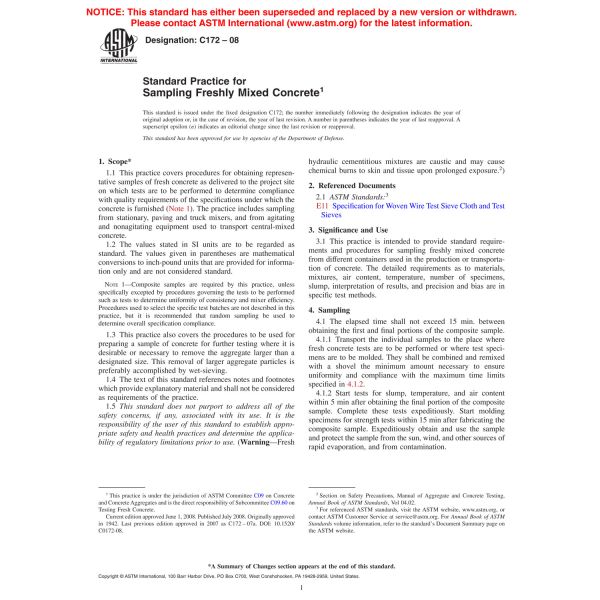
ASTM C 172—08 Practice for Sampling Freshly Mixed Concrete (PDF Download)
Item #: 8959P195
Price: $50.00
Member Price: $50.00
Member Savings: $0.00
$50.00
The PDF/Redline Download option contains PDF files of both the I-Code and a Redline version of the I-Code which shows changes from the previous edition marked in the color red. With the Redline you can see what has been changed from the previous edition. This option is a searchable PDF download that requires a PDF Reader. It is mobile compatible with mobile tablets and smart phones that support the PDF format. The PDF Download is licensed per individual, who may place the file on up to four electronic devices for their personal use. Distribution of the PDF is not permitted. For a volume license the PDF is licensed to the person to which it is assigned. Use on a local area network or other network is not permitted.
1.1 This practice covers procedures for obtaining representative samples of fresh concrete as delivered to the project site on which tests are to be performed to determine compliance with quality requirements of the specifications under which the concrete is furnished (Note 1). The practice includes sampling from stationary, paving and truck mixers, and from agitating and nonagitating equipment used to transport central-mixed concrete.1.2 The values stated in SI units are to be regarded as standard. The values given in parentheses are mathematical conversions to inch-pound units that are provided for information only and are not considered standard. Note;Composite samples are required by this practice, unless specifically excepted by procedures governing the tests to be performed such as tests to determine uniformity of consistency and mixer efficiency. Procedures used to select the specific test batches are not described in this practice, but it is recommended that random sampling be used to determine overall specification compliance. 1.3 This practice also covers the procedures to be used for preparing a sample of concrete for further testing where it is desirable or necessary to remove the aggregate larger than a designated size. This removal of larger aggregate particles is preferably accomplished by wet-sieving.1.4 The text of this standard references notes and footnotes which provide explanatory material and shall not be considered as requirements of the practice. This standard does not purport to address all of the safety concerns, if any, associated with its use. It is the responsibility of the user of this standard to establish appropriate safety and health practices and determine the applicability of regulatory limitations prior to use. Fresh hydraulic cementitious mixtures are caustic and may cause chemical burns to skin and tissue upon prolonged exposure.
This standard is referenced in the 2012 International Building Code®.
| Description: | 1.1 This practice covers procedures for obtaining representative samples of fresh concrete as delivered to the project site on which tests are to be performed to determine compliance with quality requirements of the specifications under which the concrete is furnished (Note 1). The practice includes sampling from stationary, paving and truck mixers, and from agitating and nonagitating equipment used to transport central-mixed concrete.1.2 The values stated in SI units are to be regarded as standard. The values given in parentheses are mathematical conversions to inch-pound units that are provided for information only and are not considered standard. Note;Composite samples are required by this practice, unless specifically excepted by procedures governing the tests to be performed such as tests to determine uniformity of consistency and mixer efficiency. Procedures used to select the specific test batches are not described in this practice, but it is recommended that random sampling be used to determine overall specification compliance. 1.3 This practice also covers the procedures to be used for preparing a sample of concrete for further testing where it is desirable or necessary to remove the aggregate larger than a designated size. This removal of larger aggregate particles is preferably accomplished by wet-sieving.1.4 The text of this standard references notes and footnotes which provide explanatory material and shall not be considered as requirements of the practice. This standard does not purport to address all of the safety concerns, if any, associated with its use. It is the responsibility of the user of this standard to establish appropriate safety and health practices and determine the applicability of regulatory limitations prior to use. Fresh hydraulic cementitious mixtures are caustic and may cause chemical burns to skin and tissue upon prolonged exposure. This standard is referenced in the 2012 International Building Code®. |
|---|---|
| Pages | 3 |
| Code Year | 2012 |
| Publisher | ASTM International |
| Language | English |