This is a demo store. No orders will be fulfilled.


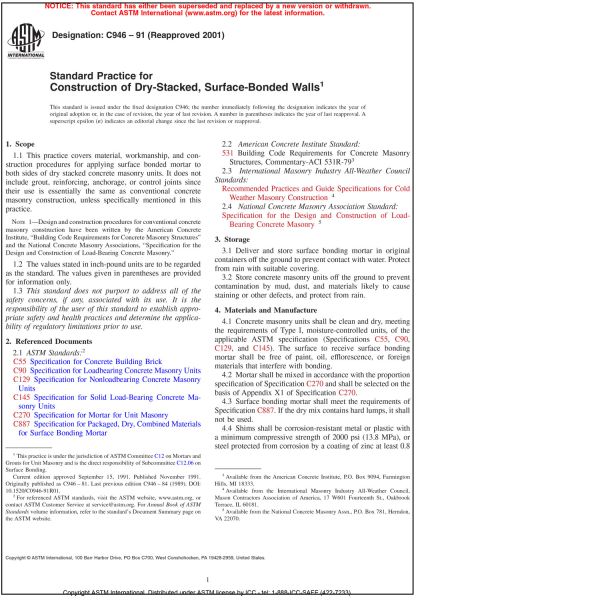
ASTM C 946—91 (2001) Specification for Practice for Construction of Dry-stacked, Surface-bonded Walls (PDF Download)
Item #: 8959P264
Price: $50.00
Member Price: $50.00
Member Savings: $0.00
$50.00
The PDF/Redline Download option contains PDF files of both the I-Code and a Redline version of the I-Code which shows changes from the previous edition marked in the color red. With the Redline you can see what has been changed from the previous edition. This option is a searchable PDF download that requires a PDF Reader. It is mobile compatible with mobile tablets and smart phones that support the PDF format. The PDF Download is licensed per individual, who may place the file on up to four electronic devices for their personal use. Distribution of the PDF is not permitted. For a volume license the PDF is licensed to the person to which it is assigned. Use on a local area network or other network is not permitted.
This practice covers material, workmanship, and construction procedures for applying surface bonded mortar to both sides of dry stacked concrete masonry units. Mortar shall be mixed and shall be selected in accordance with the proportion specification prescribed. Shims shall be corrosion-resistant metal or plastic with a required minimum compressive strength. Courses of concrete masonry units between the leveling courses shall be placed without mortar on the bed or head joints. Place units in running bond. Remove burrs and butt blocks tightly. Use shims, mortar, or surface bonding mortar to plum and level individual units when necessary. Use clean mixing equipment and water free of deleterious amounts of acid, alkali, and organic materials. Mix only full bag multiples of material to overcome any segregation of ingredients. Mixing time shall be kept to a minimum, as over mixing may cause damage to the fibers. Before applying surface bonding mortar, wet the wall uniformly with water to prevent excessive suction of water from the surface bonding mortar. Trowel- or spray-apply surface bonding mortar to both sides of dry-stacked concrete masonry units. When a second coat of surface bonding mortar is to be applied, the first coat shall have taken its initial set. Dampen the wall with a water mist after a specified time, but within a day of application of surface bonding mortar. The top of the walls shall be covered with a nonstaining, waterproof covering to prevent moisture from entering the wall until the top is permanently protected.
This standard is referenced in the 2012 International Building Code®.
| Description: | This practice covers material, workmanship, and construction procedures for applying surface bonded mortar to both sides of dry stacked concrete masonry units. Mortar shall be mixed and shall be selected in accordance with the proportion specification prescribed. Shims shall be corrosion-resistant metal or plastic with a required minimum compressive strength. Courses of concrete masonry units between the leveling courses shall be placed without mortar on the bed or head joints. Place units in running bond. Remove burrs and butt blocks tightly. Use shims, mortar, or surface bonding mortar to plum and level individual units when necessary. Use clean mixing equipment and water free of deleterious amounts of acid, alkali, and organic materials. Mix only full bag multiples of material to overcome any segregation of ingredients. Mixing time shall be kept to a minimum, as over mixing may cause damage to the fibers. Before applying surface bonding mortar, wet the wall uniformly with water to prevent excessive suction of water from the surface bonding mortar. Trowel- or spray-apply surface bonding mortar to both sides of dry-stacked concrete masonry units. When a second coat of surface bonding mortar is to be applied, the first coat shall have taken its initial set. Dampen the wall with a water mist after a specified time, but within a day of application of surface bonding mortar. The top of the walls shall be covered with a nonstaining, waterproof covering to prevent moisture from entering the wall until the top is permanently protected. This standard is referenced in the 2012 International Building Code®. |
|---|---|
| Pages | 3 |
| Code Year | 2012 |
| Publisher | ASTM International |
| Language | English |