This is a demo store. No orders will be fulfilled.


ASTM C150/C150M—12 Standard Specification for Portland Cement (PDF Download)
Item #: 8959P658
Price: $58.00
Member Price: $58.00
Member Savings: $0.00
$58.00
The PDF/Redline Download option contains PDF files of both the I-Code and a Redline version of the I-Code which shows changes from the previous edition marked in the color red. With the Redline you can see what has been changed from the previous edition. This option is a searchable PDF download that requires a PDF Reader. It is mobile compatible with mobile tablets and smart phones that support the PDF format. The PDF Download is licensed per individual, who may place the file on up to four electronic devices for their personal use. Distribution of the PDF is not permitted. For a volume license the PDF is licensed to the person to which it is assigned. Use on a local area network or other network is not permitted.
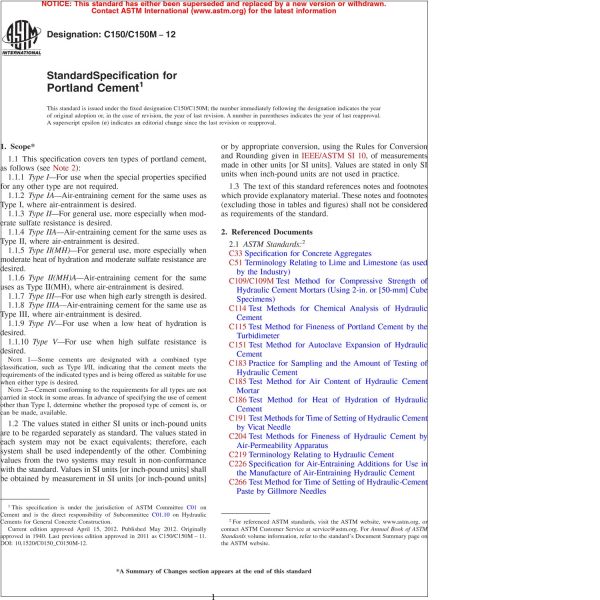
1.1 This specification covers ten types of portland cement, as follows (see Note 2):
1.1.1 Type I—For use when the special properties specified for any other type are not required.
1.1.2 Type IA—Air-entraining cement for the same uses as Type I, where air-entrainment is desired.
1.1.3 Type II—For general use, more especially when moderate sulfate resistance is desired.
1.1.4 Type IIA—Air-entraining cement for the same uses as Type II, where air-entrainment is desired.
1.1.5 Type II(MH)—For general use, more especially when moderate heat of hydration and moderate sulfate resistance are desired.
1.1.6 Type II(MH)A—Air-entraining cement for the same uses as Type II(MH), where air-entrainment is desired.
1.1.7 Type III—For use when high early strength is desired.
1.1.8 Type IIIA—Air-entraining cement for the same use as Type III, where air-entrainment is desired.
1.1.9 Type IV—For use when a low heat of hydration is desired.
1.1.10 Type V—For use when high sulfate resistance is desired.
Note 1—Some cements are designated with a combined type classification, such as Type I/II, indicating that the cement meets the requirements of the indicated types and is being offered as suitable for use when either type is desired.
Note 2—Cement conforming to the requirements for all types are not carried in stock in some areas. In advance of specifying the use of cement other than Type I, determine whether the proposed type of cement is, or can be made, available.
1.2 The values stated in either SI units or inch-pound units are to be regarded separately as standard. The values stated in each system may not be exact equivalents; therefore, each system shall be used independently of the other. Combining values from the two systems may result in non-conformance with the standard. Values in SI units [or inch-pound units] shall be obtained by measurement in SI units [or inch-pound units] or by appropriate conversion, using the Rules for Conversion and Rounding given in , of measurements made in other units [or SI units]. Values are stated in only SI units when inch-pound units are not used in practice.
1.3 The text of this standard references notes and footnotes which provide explanatory material. These notes and footnotes (excluding those in tables and figures) shall not be considered as requirements of the standard.
This standard is referenced in the 2015 International Building Code® and International Residential Code®