This is a demo store. No orders will be fulfilled.


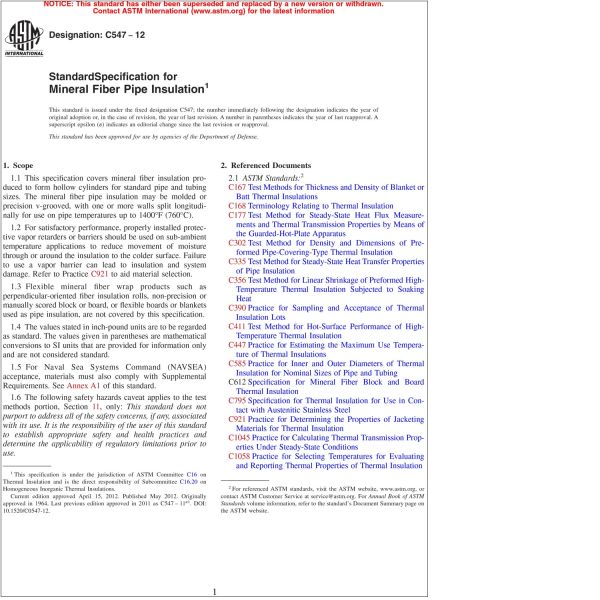
ASTM C547—12 Specification for Mineral Fiber Pipe Insulation (PDF Download)
Item #: 8959P687
Price: $58.00
Member Price: $58.00
Member Savings: $0.00
$58.00
The PDF/Redline Download option contains PDF files of both the I-Code and a Redline version of the I-Code which shows changes from the previous edition marked in the color red. With the Redline you can see what has been changed from the previous edition. This option is a searchable PDF download that requires a PDF Reader. It is mobile compatible with mobile tablets and smart phones that support the PDF format. The PDF Download is licensed per individual, who may place the file on up to four electronic devices for their personal use. Distribution of the PDF is not permitted. For a volume license the PDF is licensed to the person to which it is assigned. Use on a local area network or other network is not permitted.
1.1 This specification covers mineral fiber insulation produced to form hollow cylinders for standard pipe and tubing sizes. The mineral fiber pipe insulation may be molded or precision v-grooved, with one or more walls split longitudinally for use on pipe temperatures up to 1400°F (760°C).
1.2 For satisfactory performance, properly installed protective vapor retarders or barriers should be used on sub-ambient temperature applications to reduce movement of moisture through or around the insulation to the colder surface. Failure to use a vapor barrier can lead to insulation and system damage. Refer to Practice C921 to aid material selection.
1.3 Flexible mineral fiber wrap products such as perpendicular-oriented fiber insulation rolls, non-precision or manually scored block or board, or flexible boards or blankets used as pipe insulation, are not covered by this specification.
1.4 The values stated in inch-pound units are to be regarded as standard. The values given in parentheses are mathematical conversions to SI units that are provided for information only and are not considered standard.
1.5 For Naval Sea Systems Command (NAVSEA) acceptance, materials must also comply with Supplemental Requirements. See Annex A1 of this standard.
1.6 The following safety hazards caveat applies to the test methods portion, Section 11, only: This standard does not purport to address all of the safety concerns, if any, associated with its use. It is the responsibility of the user of this standard to establish appropriate safety and health practices and determine the applicability of regulatory limitations prior to use.
This standard is referenced in the 2015 International Building Code®.
| Description: | 1.1 This specification covers mineral fiber insulation produced to form hollow cylinders for standard pipe and tubing sizes. The mineral fiber pipe insulation may be molded or precision v-grooved, with one or more walls split longitudinally for use on pipe temperatures up to 1400°F (760°C). 1.2 For satisfactory performance, properly installed protective vapor retarders or barriers should be used on sub-ambient temperature applications to reduce movement of moisture through or around the insulation to the colder surface. Failure to use a vapor barrier can lead to insulation and system damage. Refer to Practice C921 to aid material selection. 1.3 Flexible mineral fiber wrap products such as perpendicular-oriented fiber insulation rolls, non-precision or manually scored block or board, or flexible boards or blankets used as pipe insulation, are not covered by this specification. 1.4 The values stated in inch-pound units are to be regarded as standard. The values given in parentheses are mathematical conversions to SI units that are provided for information only and are not considered standard. 1.5 For Naval Sea Systems Command (NAVSEA) acceptance, materials must also comply with Supplemental Requirements. See Annex A1 of this standard. 1.6 The following safety hazards caveat applies to the test methods portion, Section 11, only: This standard does not purport to address all of the safety concerns, if any, associated with its use. It is the responsibility of the user of this standard to establish appropriate safety and health practices and determine the applicability of regulatory limitations prior to use. This standard is referenced in the 2015 International Building Code®. |
|---|---|
| Pages | 7 |
| Code Year | 2015 |
| Publisher | ASTM International |
| Language | English |