This is a demo store. No orders will be fulfilled.


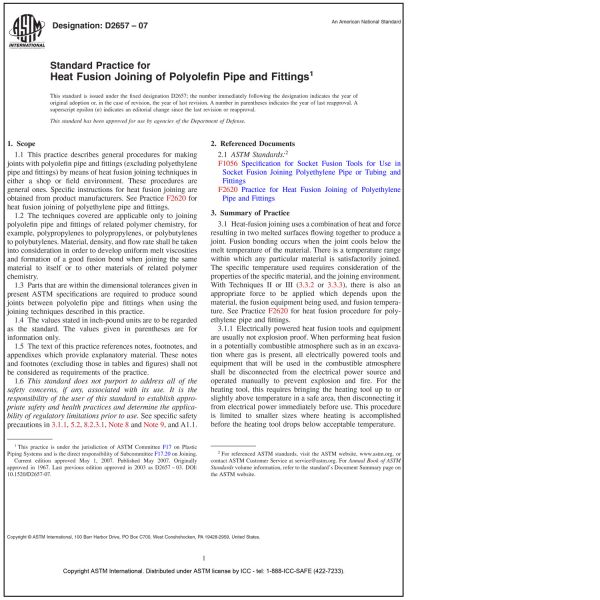
ASTM D 2657—07 Standard Practice for Heat Fusion-joining of Polyolefin Pipe Fittings (PDF Download)
Item #: 8959P368
Price: $48.00
Member Price: $48.00
Member Savings: $0.00
$48.00
The PDF/Redline Download option contains PDF files of both the I-Code and a Redline version of the I-Code which shows changes from the previous edition marked in the color red. With the Redline you can see what has been changed from the previous edition. This option is a searchable PDF download that requires a PDF Reader. It is mobile compatible with mobile tablets and smart phones that support the PDF format. The PDF Download is licensed per individual, who may place the file on up to four electronic devices for their personal use. Distribution of the PDF is not permitted. For a volume license the PDF is licensed to the person to which it is assigned. Use on a local area network or other network is not permitted.
1.1 This practice describes general procedures for making joints with polyolefin pipe and fittings (excluding polyethylene pipe and fittings) by means of heat fusion joining techniques in either a shop or field environment. These procedures are general ones. Specific instructions for heat fusion joining are obtained from product manufacturers. See Practice F 2620 for heat fusion joining of polyethylene pipe and fittings.1.2 The techniques covered are applicable only to joining polyolefin pipe and fittings of related polymer chemistry, for example, polypropylenes to polypropylenes, or polybutylenes to polybutylenes. Material, density, and flow rate shall be taken into consideration in order to develop uniform melt viscosities and formation of a good fusion bond when joining the same material to itself or to other materials of related polymer chemistry. 1.3 Parts that are within the dimensional tolerances given in present ASTM specifications are required to produce sound joints between polyolefin pipe and fittings when using the joining techniques described in this practice.1.4 The values stated in inch-pound units are to be regarded as the standard. The values given in parentheses are for information only. 1.5 The text of this practice references notes, footnotes, and appendixes which provide explanatory material. These notes and footnotes (excluding those in tables and figures) shall not be considered as requirements of the practice.1.6 This standard does not purport to address all of the safety concerns, if any, associated with its use. It is the responsibility of the user of this standard to establish appropriate safety and health practices and determine the applicability of regulatory limitations prior to use. See specific safety precautions in 3.1.1, 5.2, 8.2.3.1, Note 8 and Note 9, and A1.1.
This standard is referenced in the 2012 International Mechanical Code®, International Plumbing Code®, International Private Sewage Disposal Code®, and International Residential Code®..
| Description: | 1.1 This practice describes general procedures for making joints with polyolefin pipe and fittings (excluding polyethylene pipe and fittings) by means of heat fusion joining techniques in either a shop or field environment. These procedures are general ones. Specific instructions for heat fusion joining are obtained from product manufacturers. See Practice F 2620 for heat fusion joining of polyethylene pipe and fittings.1.2 The techniques covered are applicable only to joining polyolefin pipe and fittings of related polymer chemistry, for example, polypropylenes to polypropylenes, or polybutylenes to polybutylenes. Material, density, and flow rate shall be taken into consideration in order to develop uniform melt viscosities and formation of a good fusion bond when joining the same material to itself or to other materials of related polymer chemistry. 1.3 Parts that are within the dimensional tolerances given in present ASTM specifications are required to produce sound joints between polyolefin pipe and fittings when using the joining techniques described in this practice.1.4 The values stated in inch-pound units are to be regarded as the standard. The values given in parentheses are for information only. 1.5 The text of this practice references notes, footnotes, and appendixes which provide explanatory material. These notes and footnotes (excluding those in tables and figures) shall not be considered as requirements of the practice.1.6 This standard does not purport to address all of the safety concerns, if any, associated with its use. It is the responsibility of the user of this standard to establish appropriate safety and health practices and determine the applicability of regulatory limitations prior to use. See specific safety precautions in 3.1.1, 5.2, 8.2.3.1, Note 8 and Note 9, and A1.1. This standard is referenced in the 2012 International Mechanical Code®, International Plumbing Code®, International Private Sewage Disposal Code®, and International Residential Code®.. |
|---|---|
| Pages | 7 |
| Code Year | 2012 |
| Publisher | ASTM International |
| Language | English |