This is a demo store. No orders will be fulfilled.


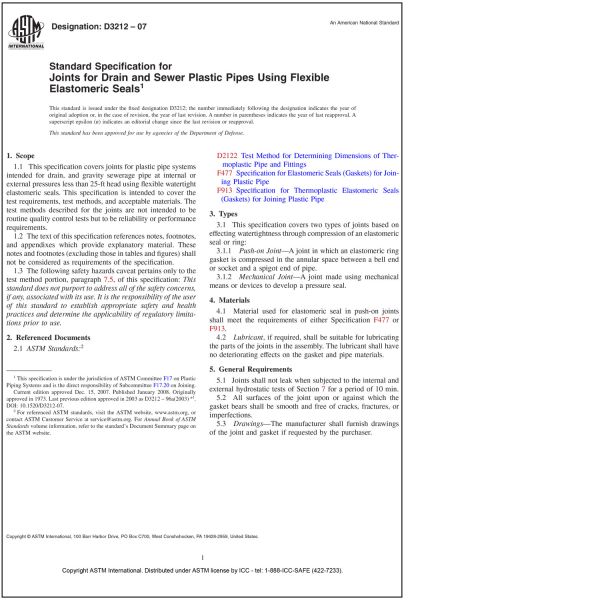
ASTM D 3212—07 Specification for Joints for Drain and Sewer Plastic Pipes Using Flexible Elastomeric Seals (PDF Download)
Item #: 8959P397
Price: $50.00
Member Price: $50.00
Member Savings: $0.00
$50.00
The PDF/Redline Download option contains PDF files of both the I-Code and a Redline version of the I-Code which shows changes from the previous edition marked in the color red. With the Redline you can see what has been changed from the previous edition. This option is a searchable PDF download that requires a PDF Reader. It is mobile compatible with mobile tablets and smart phones that support the PDF format. The PDF Download is licensed per individual, who may place the file on up to four electronic devices for their personal use. Distribution of the PDF is not permitted. For a volume license the PDF is licensed to the person to which it is assigned. Use on a local area network or other network is not permitted.
This specification covers joints for plastic pipe systems intended for drain, and gravity sewerage pipe at internal or external pressures less than a certain ft. head using flexible watertight elastomeric seals. The joints are classified into two types based on effecting watertightness through compression of an elastomeric seal or ring: push-on-joint is a joint in which an elastomeric ring gasket is compressed in the annular space between a bell end or socket and a spigot end of pipe and mechanical joint is a joint made using mechanical means or devices to develop a pressure seal. Joints shall not leak when subjected to the internal and external hydrostatic tests. All surfaces of the joint upon or against which the gasket bears shall be smooth and free of cracks, fractures, or imperfections. The gasket shall be the sole element depended upon to make the joint flexible and watertight. The gasket shall be a continuous elastomeric ring. In mechanical joints, the pipe spigot shall have a wall thickness sufficient to withstand, without deformation or collapse, the compressive force exerted when the fitting is tightened. Some joint designs provide for the angular deflection of a pipe joint, without reducing watertightness. Where greater deflections are required than permitted by the joint design, suitable fittings must be provided. The joint components shall be of such design that they will withstand the forces caused by the compression of the gasket when joined without cracking or fracturing when tested. Dimensions of joint components and gaskets shall meet the requirements specified. Test methods such as internal pressure test and vacuum test shall be performed.
This standard is referenced in the 2012 International Plumbing Code®, International Private Sewage Disposal Code®, and International Residential Code®..
| Description: | This specification covers joints for plastic pipe systems intended for drain, and gravity sewerage pipe at internal or external pressures less than a certain ft. head using flexible watertight elastomeric seals. The joints are classified into two types based on effecting watertightness through compression of an elastomeric seal or ring: push-on-joint is a joint in which an elastomeric ring gasket is compressed in the annular space between a bell end or socket and a spigot end of pipe and mechanical joint is a joint made using mechanical means or devices to develop a pressure seal. Joints shall not leak when subjected to the internal and external hydrostatic tests. All surfaces of the joint upon or against which the gasket bears shall be smooth and free of cracks, fractures, or imperfections. The gasket shall be the sole element depended upon to make the joint flexible and watertight. The gasket shall be a continuous elastomeric ring. In mechanical joints, the pipe spigot shall have a wall thickness sufficient to withstand, without deformation or collapse, the compressive force exerted when the fitting is tightened. Some joint designs provide for the angular deflection of a pipe joint, without reducing watertightness. Where greater deflections are required than permitted by the joint design, suitable fittings must be provided. The joint components shall be of such design that they will withstand the forces caused by the compression of the gasket when joined without cracking or fracturing when tested. Dimensions of joint components and gaskets shall meet the requirements specified. Test methods such as internal pressure test and vacuum test shall be performed. This standard is referenced in the 2012 International Plumbing Code®, International Private Sewage Disposal Code®, and International Residential Code®.. |
|---|---|
| Pages | 3 |
| Code Year | 2012 |
| Publisher | ASTM International |
| Language | English |