This is a demo store. No orders will be fulfilled.


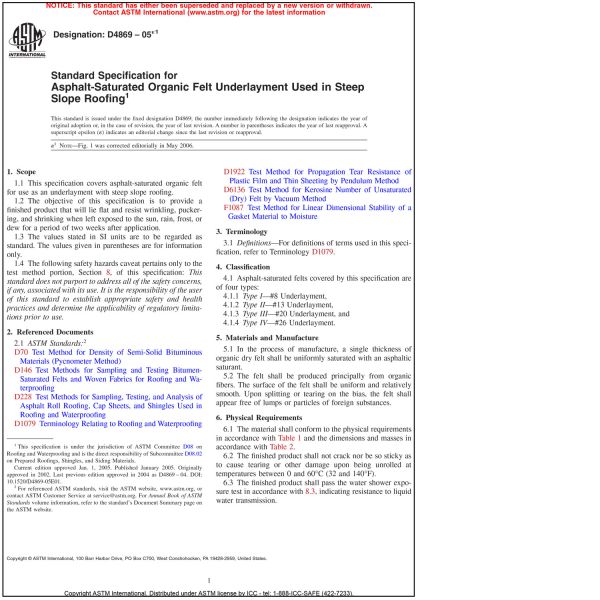
ASTM D 4869—05e01 Specification for Asphalt-saturated (Organic Felt) — Underlayment Used in Steep Slope Roofing (PDF Download)
Item #: 8959P427
Price: $50.00
Member Price: $50.00
Member Savings: $0.00
$50.00
The PDF/Redline Download option contains PDF files of both the I-Code and a Redline version of the I-Code which shows changes from the previous edition marked in the color red. With the Redline you can see what has been changed from the previous edition. This option is a searchable PDF download that requires a PDF Reader. It is mobile compatible with mobile tablets and smart phones that support the PDF format. The PDF Download is licensed per individual, who may place the file on up to four electronic devices for their personal use. Distribution of the PDF is not permitted. For a volume license the PDF is licensed to the person to which it is assigned. Use on a local area network or other network is not permitted.
This specification covers asphalt-saturated organic felt for use as an underlayment in steep slope roofing. The objective of this specification is to provide a finished product that will lie flat and resist wrinkling, puckering, and shrinking when left exposed to the sun, rain, frost, or dew for a period of two weeks after application. In the process of manufacture, a single thickness of organic dry felt shall be uniformly saturated with an asphaltic saturant and the felt shall be produced principally from organic fibers. The surface of the felt shall be uniform and relatively smooth and upon splitting or tearing on the bias, the felt shall appear free of lumps or particles of foreign substances. The material shall conform to the prescribed physical requirements such as tear strength, pliability, loss on heating, liquid water transmission, breaking strength, and dimensional stability, and to the specified dimension and mass requirements such as roll width, roll area, net mass of saturated felt, net mass of desaturated felt, saturation, moisture, and saturating efficiency. The finished product shall not crack nor be so sticky as to cause tearing or other damage upon being unrolled. The following tests shall be taken: (1) determination of saturation percent of felt, (2) determination of resistance to liquid water transmission using water shower exposure test, and (3) test for dimensional stability to low and high humidity. The water shower exposure test for underlayment is illustrated.
This standard is referenced in the 2012 International Building Code® and the International Residential Code®.
| Description: | This specification covers asphalt-saturated organic felt for use as an underlayment in steep slope roofing. The objective of this specification is to provide a finished product that will lie flat and resist wrinkling, puckering, and shrinking when left exposed to the sun, rain, frost, or dew for a period of two weeks after application. In the process of manufacture, a single thickness of organic dry felt shall be uniformly saturated with an asphaltic saturant and the felt shall be produced principally from organic fibers. The surface of the felt shall be uniform and relatively smooth and upon splitting or tearing on the bias, the felt shall appear free of lumps or particles of foreign substances. The material shall conform to the prescribed physical requirements such as tear strength, pliability, loss on heating, liquid water transmission, breaking strength, and dimensional stability, and to the specified dimension and mass requirements such as roll width, roll area, net mass of saturated felt, net mass of desaturated felt, saturation, moisture, and saturating efficiency. The finished product shall not crack nor be so sticky as to cause tearing or other damage upon being unrolled. The following tests shall be taken: (1) determination of saturation percent of felt, (2) determination of resistance to liquid water transmission using water shower exposure test, and (3) test for dimensional stability to low and high humidity. The water shower exposure test for underlayment is illustrated. This standard is referenced in the 2012 International Building Code® and the International Residential Code®. |
|---|---|
| Pages | 4 |
| Code Year | 2012 |
| Publisher | ASTM International |
| Language | English |