This is a demo store. No orders will be fulfilled.


ASTM D 6305—08 Practice for Calculating Bending Strength Design Adjustment Factors for Fire-retardant-treated Plywood Roof Sheathing (PDF Download)
Item #: 8959P455
Price: $48.00
Member Price: $48.00
Member Savings: $0.00
$48.00
The PDF/Redline Download option contains PDF files of both the I-Code and a Redline version of the I-Code which shows changes from the previous edition marked in the color red. With the Redline you can see what has been changed from the previous edition. This option is a searchable PDF download that requires a PDF Reader. It is mobile compatible with mobile tablets and smart phones that support the PDF format. The PDF Download is licensed per individual, who may place the file on up to four electronic devices for their personal use. Distribution of the PDF is not permitted. For a volume license the PDF is licensed to the person to which it is assigned. Use on a local area network or other network is not permitted.
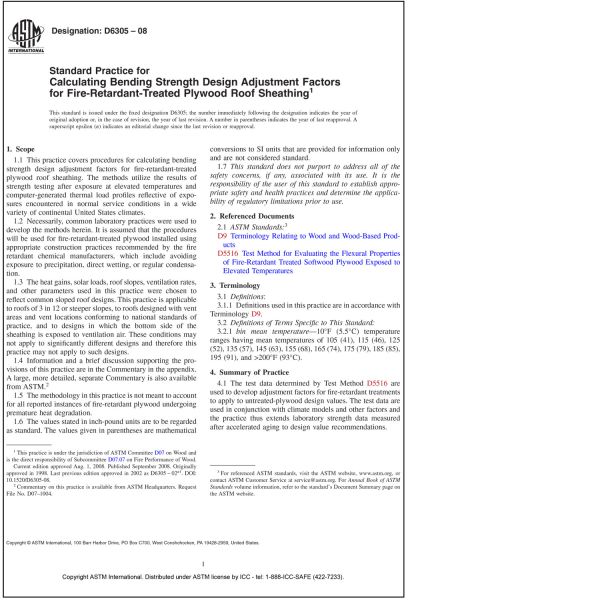
1.1 This practice covers procedures for calculating bending strength design adjustment factors for fire-retardant-treated plywood roof sheathing. The methods utilize the results of strength testing after exposure at elevated temperatures and computer-generated thermal load profiles reflective of exposures encountered in normal service conditions in a wide variety of continental United States climates. 1.2 Necessarily, common laboratory practices were used to develop the methods herein. It is assumed that the procedures will be used for fire-retardant-treated plywood installed using appropriate construction practices recommended by the fire retardant chemical manufacturers, which include avoiding exposure to precipitation, direct wetting, or regular condensation. 1.3 The heat gains, solar loads, roof slopes, ventilation rates, and other parameters used in this practice were chosen to reflect common sloped roof designs. This practice is applicable to roofs of 3 in 12 or steeper slopes, to roofs designed with vent areas and vent locations conforming to national standards of practice, and to designs in which the bottom side of the sheathing is exposed to ventilation air. These conditions may not apply to significantly different designs and therefore this practice may not apply to such designs. 1.4 Information and a brief discussion supporting the provisions of this practice are in the Commentary in the appendix. A large, more detailed, separate Commentary is also available from ASTM. 1.5 The methodology in this practice is not meant to account for all reported instances of fire-retardant plywood undergoing premature heat degradation. 1.6 The values stated in inch-pound units are to be regarded as standard. The values given in parentheses are mathematical conversions to SI units that are provided for information only and are not considered standard. 1.7 This standard does not purport to address all of the safety concerns, if any, associated with its use. It is the responsibility of the user of this standard to establish appropriate safety and health practices and determine the applicability of regulatory limitations prior to use.
This standard is referenced in the 2012 International Building Code® and the International Residential Code®.
| Description: | 1.1 This practice covers procedures for calculating bending strength design adjustment factors for fire-retardant-treated plywood roof sheathing. The methods utilize the results of strength testing after exposure at elevated temperatures and computer-generated thermal load profiles reflective of exposures encountered in normal service conditions in a wide variety of continental United States climates. 1.2 Necessarily, common laboratory practices were used to develop the methods herein. It is assumed that the procedures will be used for fire-retardant-treated plywood installed using appropriate construction practices recommended by the fire retardant chemical manufacturers, which include avoiding exposure to precipitation, direct wetting, or regular condensation. 1.3 The heat gains, solar loads, roof slopes, ventilation rates, and other parameters used in this practice were chosen to reflect common sloped roof designs. This practice is applicable to roofs of 3 in 12 or steeper slopes, to roofs designed with vent areas and vent locations conforming to national standards of practice, and to designs in which the bottom side of the sheathing is exposed to ventilation air. These conditions may not apply to significantly different designs and therefore this practice may not apply to such designs. 1.4 Information and a brief discussion supporting the provisions of this practice are in the Commentary in the appendix. A large, more detailed, separate Commentary is also available from ASTM. 1.5 The methodology in this practice is not meant to account for all reported instances of fire-retardant plywood undergoing premature heat degradation. 1.6 The values stated in inch-pound units are to be regarded as standard. The values given in parentheses are mathematical conversions to SI units that are provided for information only and are not considered standard. 1.7 This standard does not purport to address all of the safety concerns, if any, associated with its use. It is the responsibility of the user of this standard to establish appropriate safety and health practices and determine the applicability of regulatory limitations prior to use. This standard is referenced in the 2012 International Building Code® and the International Residential Code®. |
|---|---|
| Pages | 6 |
| Code Year | 2012 |
| Publisher | ASTM International |
| Language | English |