This is a demo store. No orders will be fulfilled.


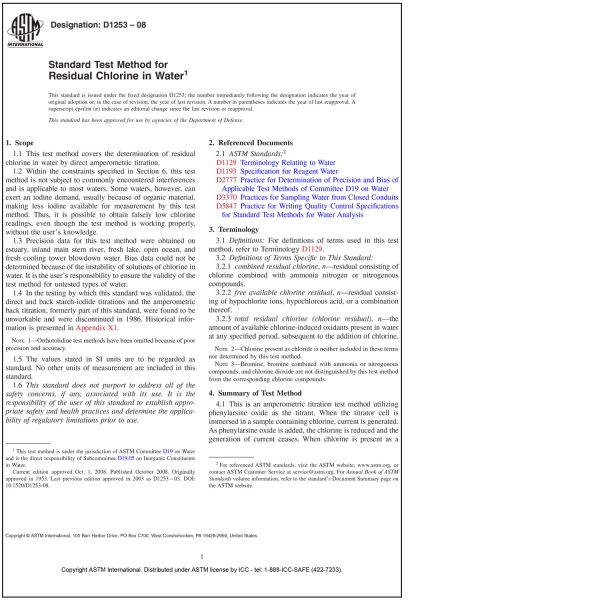
ASTM D1253-08 Standard Test Method for Residual Chlorine in Water (PDF Download)
Item #: 8959P332
Price: $48.00
Member Price: $48.00
Member Savings: $0.00
$48.00
The PDF/Redline Download option contains PDF files of both the I-Code and a Redline version of the I-Code which shows changes from the previous edition marked in the color red. With the Redline you can see what has been changed from the previous edition. This option is a searchable PDF download that requires a PDF Reader. It is mobile compatible with mobile tablets and smart phones that support the PDF format. The PDF Download is licensed per individual, who may place the file on up to four electronic devices for their personal use. Distribution of the PDF is not permitted. For a volume license the PDF is licensed to the person to which it is assigned. Use on a local area network or other network is not permitted.
This test method covers the determination of residual chlorine in water by direct amperometric titration. Within the constraints specified in Section 6, this test method is not subject to commonly encountered interferences and is applicable to most waters. Some waters, however, can exert an iodine demand, usually because of organic material, making less iodine available for measurement by this test method. Thus, it is possible to obtain falsely low chlorine readings, even though the test method is working properly, without the user's knowledge. 1.3 Precision data for this test method were obtained on estuary, inland main stem river, fresh lake, open ocean, and fresh cooling tower blowdown water. Bias data could not be determined because of the instability of solutions of chlorine in water. It is the user's responsibility to ensure the validity of the test method for untested types of water. 1.4 In the testing by which this standard was validated, the direct and back starch-iodide titrations and the amperometric back titration, formerly part of this standard, were found to be unworkable and were discontinued in 1986. Historical information is presented in Appendix X1. Note;Orthotolidine test methods have been omitted because of poor precision and accuracy. 1.5 The values stated in SI units are to be regarded as standard. No other units of measurement are included in this standard. 1.6 This standard does not purport to address all of the safety concerns, if any, associated with its use. It is the responsibility of the user of this standard to establish appropriate safety and health practices and determine the applicability of regulatory limitations prior to use.
This standard is referenced in the 2012 International Green Construction Code™.
| Description: | This test method covers the determination of residual chlorine in water by direct amperometric titration. Within the constraints specified in Section 6, this test method is not subject to commonly encountered interferences and is applicable to most waters. Some waters, however, can exert an iodine demand, usually because of organic material, making less iodine available for measurement by this test method. Thus, it is possible to obtain falsely low chlorine readings, even though the test method is working properly, without the user's knowledge. 1.3 Precision data for this test method were obtained on estuary, inland main stem river, fresh lake, open ocean, and fresh cooling tower blowdown water. Bias data could not be determined because of the instability of solutions of chlorine in water. It is the user's responsibility to ensure the validity of the test method for untested types of water. 1.4 In the testing by which this standard was validated, the direct and back starch-iodide titrations and the amperometric back titration, formerly part of this standard, were found to be unworkable and were discontinued in 1986. Historical information is presented in Appendix X1. Note;Orthotolidine test methods have been omitted because of poor precision and accuracy. 1.5 The values stated in SI units are to be regarded as standard. No other units of measurement are included in this standard. 1.6 This standard does not purport to address all of the safety concerns, if any, associated with its use. It is the responsibility of the user of this standard to establish appropriate safety and health practices and determine the applicability of regulatory limitations prior to use. This standard is referenced in the 2012 International Green Construction Code™. |
|---|---|
| Pages | 5 |
| Code Year | 2012 |
| Publisher | ASTM International |
| Language | English |