This is a demo store. No orders will be fulfilled.


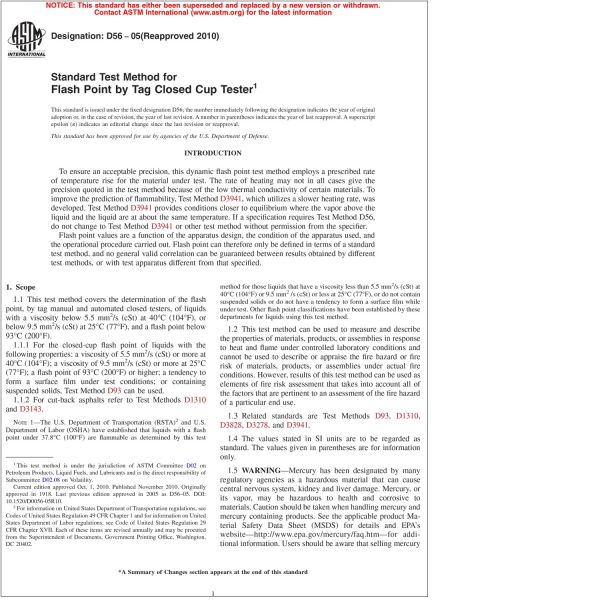
ASTM D56—05(2010) Standard Test Method for Flash Point By Tag Closed Tester (PDF Download)
Item #: 8959P763
Price: $65.00
Member Price: $65.00
Member Savings: $0.00
$65.00
The PDF/Redline Download option contains PDF files of both the I-Code and a Redline version of the I-Code which shows changes from the previous edition marked in the color red. With the Redline you can see what has been changed from the previous edition. This option is a searchable PDF download that requires a PDF Reader. It is mobile compatible with mobile tablets and smart phones that support the PDF format. The PDF Download is licensed per individual, who may place the file on up to four electronic devices for their personal use. Distribution of the PDF is not permitted. For a volume license the PDF is licensed to the person to which it is assigned. Use on a local area network or other network is not permitted.
1.1 This test method covers the determination of the flash point, by tag manual and automated closed testers, of liquids with a viscosity below 5.5 mm2/s (cSt) at 40°C (104°F), or below 9.5 mm2/s (cSt) at 25°C (77°F), and a flash point below 93°C (200°F).
1.1.1 For the closed-cup flash point of liquids with the following properties: a viscosity of 5.5 mm2/s (cSt) or more at 40°C (104°F); a viscosity of 9.5 mm2/s (cSt) or more at 25°C (77°F); a flash point of 93°C (200°F) or higher; a tendency to form a surface film under test conditions; or containing suspended solids, Test Method D93 can be used.
1.1.2 For cut-back asphalts refer to Test Methods D1310 and D3143.
Note 1—The U.S. Department of Transportation (RSTA) and U.S. Department of Labor (OSHA) have established that liquids with a flash point under 37.8°C (100°F) are flammable as determined by this test method for those liquids that have a viscosity less than 5.5 mm2/s (cSt) at 40°C (104°F) or 9.5 mm2/s (cSt) or less at 25°C (77°F), or do not contain suspended solids or do not have a tendency to form a surface film while under test. Other flash point classifications have been established by these departments for liquids using this test method.
1.2 This test method can be used to measure and describe the properties of materials, products, or assemblies in response to heat and flame under controlled laboratory conditions and cannot be used to describe or appraise the fire hazard or fire risk of materials, products, or assemblies under actual fire conditions. However, results of this test method can be used as elements of fire risk assessment that takes into account all of the factors that are pertinent to an assessment of the fire hazard of a particular end use.
1.3 Related standards are Test Methods D93, D1310, D3828, D3278, and D3941.
1.4 The values stated in SI units are to be regarded as standard. The values given in parentheses are for information only.
1.5 WARNING
1.6 This standard does not purport to address all of the safety concerns, if any, associated with its use. It is the responsibility of the user of this standard to establish appropriate safety and health practices and determine the applicability of regulatory limitations prior to use. For specific warning statements see 8.2, 8.3, 9.5, 12.5, and refer to Material Safety Data Sheets.
This standard is referenced in the 2015 International Building Code® 2015 International Fire Code® and 2015 International Mechanical Code®.
| Description: | 1.1 This test method covers the determination of the flash point, by tag manual and automated closed testers, of liquids with a viscosity below 5.5 mm2/s (cSt) at 40°C (104°F), or below 9.5 mm2/s (cSt) at 25°C (77°F), and a flash point below 93°C (200°F). 1.1.1 For the closed-cup flash point of liquids with the following properties: a viscosity of 5.5 mm2/s (cSt) or more at 40°C (104°F); a viscosity of 9.5 mm2/s (cSt) or more at 25°C (77°F); a flash point of 93°C (200°F) or higher; a tendency to form a surface film under test conditions; or containing suspended solids, Test Method D93 can be used. 1.1.2 For cut-back asphalts refer to Test Methods D1310 and D3143. Note 1—The U.S. Department of Transportation (RSTA) and U.S. Department of Labor (OSHA) have established that liquids with a flash point under 37.8°C (100°F) are flammable as determined by this test method for those liquids that have a viscosity less than 5.5 mm2/s (cSt) at 40°C (104°F) or 9.5 mm2/s (cSt) or less at 25°C (77°F), or do not contain suspended solids or do not have a tendency to form a surface film while under test. Other flash point classifications have been established by these departments for liquids using this test method. 1.2 This test method can be used to measure and describe the properties of materials, products, or assemblies in response to heat and flame under controlled laboratory conditions and cannot be used to describe or appraise the fire hazard or fire risk of materials, products, or assemblies under actual fire conditions. However, results of this test method can be used as elements of fire risk assessment that takes into account all of the factors that are pertinent to an assessment of the fire hazard of a particular end use. 1.3 Related standards are Test Methods D93, D1310, D3828, D3278, and D3941. 1.4 The values stated in SI units are to be regarded as standard. The values given in parentheses are for information only. 1.5 WARNING 1.6 This standard does not purport to address all of the safety concerns, if any, associated with its use. It is the responsibility of the user of this standard to establish appropriate safety and health practices and determine the applicability of regulatory limitations prior to use. For specific warning statements see 8.2, 8.3, 9.5, 12.5, and refer to Material Safety Data Sheets. This standard is referenced in the 2015 International Building Code® 2015 International Fire Code® and 2015 International Mechanical Code®. |
|---|---|
| Pages | 12 |
| Code Year | 2015 |
| Publisher | ASTM International |
| Language | English |