This is a demo store. No orders will be fulfilled.


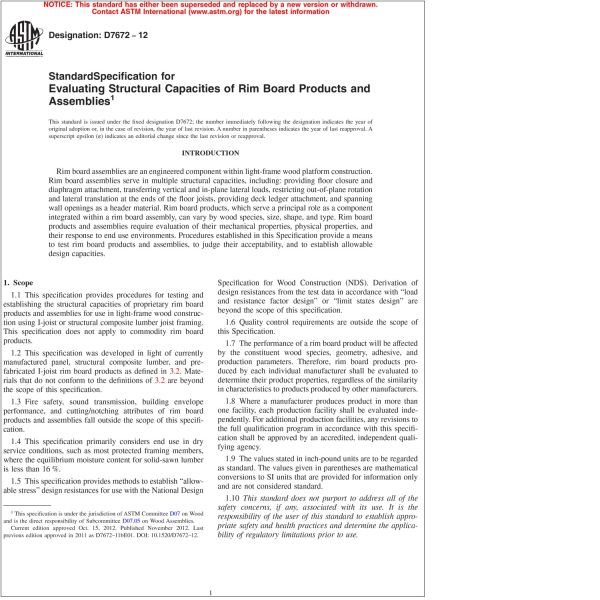
ASTM D7672—12 Standard Specification for Evaluating Structural Capacities of Rim Board Products and Assemblies (PDF Download)
Item #: 8959P853
Price: $65.00
Member Price: $65.00
Member Savings: $0.00
$65.00
The PDF/Redline Download option contains PDF files of both the I-Code and a Redline version of the I-Code which shows changes from the previous edition marked in the color red. With the Redline you can see what has been changed from the previous edition. This option is a searchable PDF download that requires a PDF Reader. It is mobile compatible with mobile tablets and smart phones that support the PDF format. The PDF Download is licensed per individual, who may place the file on up to four electronic devices for their personal use. Distribution of the PDF is not permitted. For a volume license the PDF is licensed to the person to which it is assigned. Use on a local area network or other network is not permitted.
1.1 This specification provides procedures for testing and establishing the structural capacities of proprietary rim board products and assemblies for use in light-frame wood construction using I-joist or structural composite lumber joist framing. This specification does not apply to commodity rim board products.
1.2 This specification was developed in light of currently manufactured panel, structural composite lumber, and pre-fabricated I-joist rim board products as defined in 3.2. Materials that do not conform to the definitions of 3.2 are beyond the scope of this specification.
1.3 Fire safety, sound transmission, building envelope performance, and cutting/notching attributes of rim board products and assemblies fall outside the scope of this specification.
1.4 This specification primarily considers end use in dry service conditions, such as most protected framing members, where the equilibrium moisture content for solid-sawn lumber is less than 16 %.
1.5 This specification provides methods to establish “allowable stress” design resistances for use with the National Design Specification for Wood Construction (NDS). Derivation of design resistances from the test data in accordance with “load and resistance factor design” or “limit states design” are beyond the scope of this specification.
1.7 The performance of a rim board product will be affected by the constituent wood species, geometry, adhesive, and production parameters. Therefore, rim board products produced by each individual manufacturer shall be evaluated to determine their product properties, regardless of the similarity in characteristics to products produced by other manufacturers.
1.8 Where a manufacturer produces product in more than one facility, each production facility shall be evaluated independently. For additional production facilities, any revisions to the full qualification program in accordance with this specification shall be approved by an accredited, independent qualifying agency.
1.9 The values stated in inch-pound units are to be regarded as standard. The values given in parentheses are mathematical conversions to SI units that are provided for information only and are not considered standard.
1.10 This standard does not purport to address all of the safety concerns, if any, associated with its use. It is the responsibility of the user of this standard to establish appropriate safety and health practices and determine the applicability of regulatory limitations prior to use.
This standard is referenced in the 2015 International Building Code® and 2015 International Residential Code®.
| Description: | 1.1 This specification provides procedures for testing and establishing the structural capacities of proprietary rim board products and assemblies for use in light-frame wood construction using I-joist or structural composite lumber joist framing. This specification does not apply to commodity rim board products. 1.2 This specification was developed in light of currently manufactured panel, structural composite lumber, and pre-fabricated I-joist rim board products as defined in 3.2. Materials that do not conform to the definitions of 3.2 are beyond the scope of this specification. 1.3 Fire safety, sound transmission, building envelope performance, and cutting/notching attributes of rim board products and assemblies fall outside the scope of this specification. 1.4 This specification primarily considers end use in dry service conditions, such as most protected framing members, where the equilibrium moisture content for solid-sawn lumber is less than 16 %. 1.5 This specification provides methods to establish “allowable stress” design resistances for use with the National Design Specification for Wood Construction (NDS). Derivation of design resistances from the test data in accordance with “load and resistance factor design” or “limit states design” are beyond the scope of this specification. 1.7 The performance of a rim board product will be affected by the constituent wood species, geometry, adhesive, and production parameters. Therefore, rim board products produced by each individual manufacturer shall be evaluated to determine their product properties, regardless of the similarity in characteristics to products produced by other manufacturers. 1.8 Where a manufacturer produces product in more than one facility, each production facility shall be evaluated independently. For additional production facilities, any revisions to the full qualification program in accordance with this specification shall be approved by an accredited, independent qualifying agency. 1.9 The values stated in inch-pound units are to be regarded as standard. The values given in parentheses are mathematical conversions to SI units that are provided for information only and are not considered standard. 1.10 This standard does not purport to address all of the safety concerns, if any, associated with its use. It is the responsibility of the user of this standard to establish appropriate safety and health practices and determine the applicability of regulatory limitations prior to use. This standard is referenced in the 2015 International Building Code® and 2015 International Residential Code®. |
|---|---|
| Pages | 17 |
| Code Year | 2015 |
| Publisher | ASTM International |
| Language | English |