This is a demo store. No orders will be fulfilled.


ASTM E779—10 Standard Test Method for Determining Air Leakage Rate by Fan Pressurization (PDF Download)
Item #: 8959P864
Price: $54.00
Member Price: $54.00
Member Savings: $0.00
$54.00
The PDF/Redline Download option contains PDF files of both the I-Code and a Redline version of the I-Code which shows changes from the previous edition marked in the color red. With the Redline you can see what has been changed from the previous edition. This option is a searchable PDF download that requires a PDF Reader. It is mobile compatible with mobile tablets and smart phones that support the PDF format. The PDF Download is licensed per individual, who may place the file on up to four electronic devices for their personal use. Distribution of the PDF is not permitted. For a volume license the PDF is licensed to the person to which it is assigned. Use on a local area network or other network is not permitted.
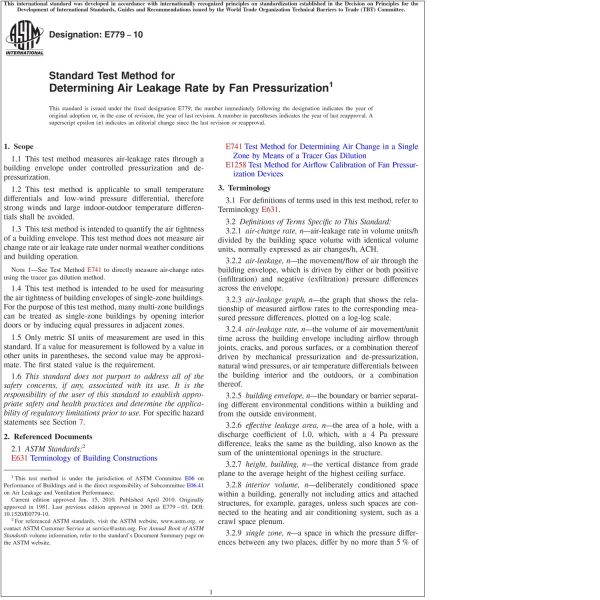
1.1 This test method measures air-leakage rates through a building envelope under controlled pressurization and de-pressurization.
1.2 This test method is applicable to small temperature differentials and low-wind pressure differential, therefore strong winds and large indoor-outdoor temperature differentials shall be avoided.
1.3 This test method is intended to quantify the air tightness of a building envelope. This test method does not measure air change rate or air leakage rate under normal weather conditions and building operation.
Note 1—See Test Method E741 to directly measure air-change rates using the tracer gas dilution method
1.4 This test method is intended to be used for measuring the air tightness of building envelopes of single-zone buildings. For the purpose of this test method, many multi-zone buildings can be treated as single-zone buildings by opening interior doors or by inducing equal pressures in adjacent zones.
1.5 Only metric SI units of measurement are used in this standard. If a value for measurement is followed by a value in other units in parentheses, the second value may be approximate. The first stated value is the requirement.
1.6 This standard does not purport to address all of the safety concerns, if any, associated with its use. It is the responsibility of the user of this standard to establish appropriate safety and health practices and determine the applicability of regulatory limitations prior to use. For specific hazard statements see Section 7.
This standard is referenced in the 2015 International Residential Code®, 2015 International Energy Conservation Code® - Commercial and 2015 International Energy Conservation Code® - Residential.
| Description: | 1.1 This test method measures air-leakage rates through a building envelope under controlled pressurization and de-pressurization. 1.2 This test method is applicable to small temperature differentials and low-wind pressure differential, therefore strong winds and large indoor-outdoor temperature differentials shall be avoided. 1.3 This test method is intended to quantify the air tightness of a building envelope. This test method does not measure air change rate or air leakage rate under normal weather conditions and building operation. Note 1—See Test Method E741 to directly measure air-change rates using the tracer gas dilution method 1.4 This test method is intended to be used for measuring the air tightness of building envelopes of single-zone buildings. For the purpose of this test method, many multi-zone buildings can be treated as single-zone buildings by opening interior doors or by inducing equal pressures in adjacent zones. 1.5 Only metric SI units of measurement are used in this standard. If a value for measurement is followed by a value in other units in parentheses, the second value may be approximate. The first stated value is the requirement. 1.6 This standard does not purport to address all of the safety concerns, if any, associated with its use. It is the responsibility of the user of this standard to establish appropriate safety and health practices and determine the applicability of regulatory limitations prior to use. For specific hazard statements see Section 7. This standard is referenced in the 2015 International Residential Code®, 2015 International Energy Conservation Code® - Commercial and 2015 International Energy Conservation Code® - Residential. |
|---|---|
| Pages | 11 |
| Code Year | 2015 |
| Publisher | ASTM International |
| Language | English |