This is a demo store. No orders will be fulfilled.


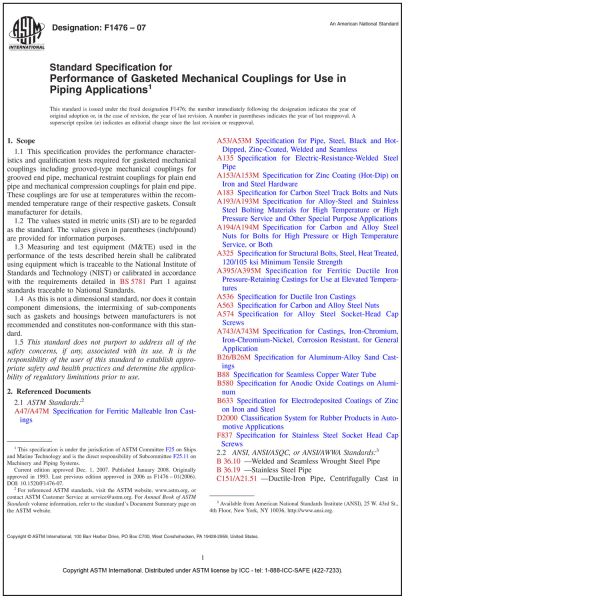
ASTM F 1476—07 Specification for Performance of Gasketed Mechanical Couplings for Use in Piping Applications (PDF Download)
Item #: 8959P548
Price: $54.00
Member Price: $54.00
Member Savings: $0.00
$54.00
The PDF/Redline Download option contains PDF files of both the I-Code and a Redline version of the I-Code which shows changes from the previous edition marked in the color red. With the Redline you can see what has been changed from the previous edition. This option is a searchable PDF download that requires a PDF Reader. It is mobile compatible with mobile tablets and smart phones that support the PDF format. The PDF Download is licensed per individual, who may place the file on up to four electronic devices for their personal use. Distribution of the PDF is not permitted. For a volume license the PDF is licensed to the person to which it is assigned. Use on a local area network or other network is not permitted.
This specification provides the performance characteristics and qualification tests required for gasket mechanical couplings (GMCs) including grooved-type mechanical couplings for grooved end pipe, mechanical restraint couplings for plain end pipe and mechanical compression couplings for plain end pipe. These couplings are for use at temperatures within the recommended temperature range of their respective gaskets. The GMCs are classified into two types: Type I which are the groove mechanical couplings and Type II which are plain end mechanical couplings. Also, they can be classified into various grades based on successful completion of testing. They can also be grouped into three classes in accordance to joint characteristics: Class 1 which is rigid and restrained, Class 2 which is flexible and restrained, and Class 3 which is flexible and unrestrained. The housings of grooved GMCs shall be made from either ductile iron, aluminum alloy, or iron-chromium-nickel alloy. Bolts of these couplings shall be made from carbon steel and corrosion resistant materials. As for plain end GMCs, their housings or center sleeves shall be made from either ductile iron or steel materials. Their bolts shall be constructed with carbon steel and corrosion resistant materials. Standard qualification tests for GMC shall consist of the following: performance test, specimen examination, pneumatic proof test, vacuum test, hydrostatic proof test, flexibility test, hydrostatic burst test, rigidity test, bending moment proof test, and bending moment ultimate test.
This standard is referenced in the 2012 International Mechanical Code®.
| Description: | This specification provides the performance characteristics and qualification tests required for gasket mechanical couplings (GMCs) including grooved-type mechanical couplings for grooved end pipe, mechanical restraint couplings for plain end pipe and mechanical compression couplings for plain end pipe. These couplings are for use at temperatures within the recommended temperature range of their respective gaskets. The GMCs are classified into two types: Type I which are the groove mechanical couplings and Type II which are plain end mechanical couplings. Also, they can be classified into various grades based on successful completion of testing. They can also be grouped into three classes in accordance to joint characteristics: Class 1 which is rigid and restrained, Class 2 which is flexible and restrained, and Class 3 which is flexible and unrestrained. The housings of grooved GMCs shall be made from either ductile iron, aluminum alloy, or iron-chromium-nickel alloy. Bolts of these couplings shall be made from carbon steel and corrosion resistant materials. As for plain end GMCs, their housings or center sleeves shall be made from either ductile iron or steel materials. Their bolts shall be constructed with carbon steel and corrosion resistant materials. Standard qualification tests for GMC shall consist of the following: performance test, specimen examination, pneumatic proof test, vacuum test, hydrostatic proof test, flexibility test, hydrostatic burst test, rigidity test, bending moment proof test, and bending moment ultimate test. This standard is referenced in the 2012 International Mechanical Code®. |
|---|---|
| Pages | 17 |
| Code Year | 2012 |
| Publisher | ASTM International |
| Language | English |