This is a demo store. No orders will be fulfilled.


ASTM F2855—12 Standard Specification for Chlorinated Poly (Vinyl Chloride)/Aluminum/Chlorinated Poly (Vinyl Chloride) (CPVC AL CPVC) Composite Pressure Tubing (PDF Download)
Item #: 8959P938
Price: $48.00
Member Price: $48.00
Member Savings: $0.00
$48.00
The PDF/Redline Download option contains PDF files of both the I-Code and a Redline version of the I-Code which shows changes from the previous edition marked in the color red. With the Redline you can see what has been changed from the previous edition. This option is a searchable PDF download that requires a PDF Reader. It is mobile compatible with mobile tablets and smart phones that support the PDF format. The PDF Download is licensed per individual, who may place the file on up to four electronic devices for their personal use. Distribution of the PDF is not permitted. For a volume license the PDF is licensed to the person to which it is assigned. Use on a local area network or other network is not permitted.
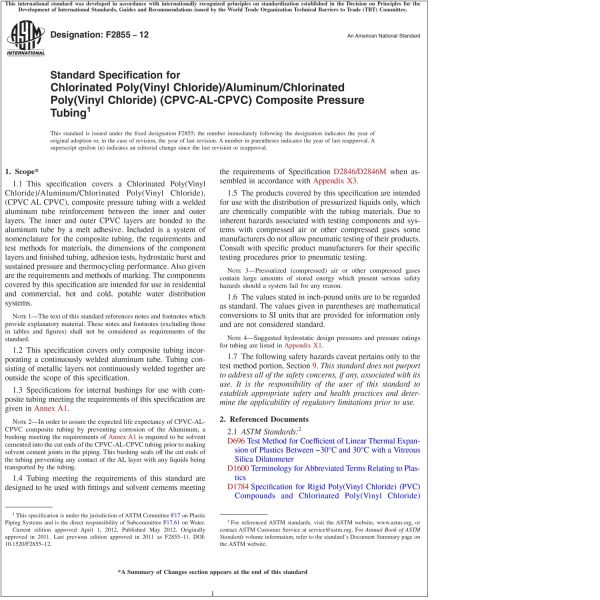
1.1 This specification covers a Chlorinated Poly(Vinyl Chloride)/Aluminum/Chlorinated Poly(Vinyl Chloride), (CPVC AL CPVC), composite pressure tubing with a welded aluminum tube reinforcement between the inner and outer layers. The inner and outer CPVC layers are bonded to the aluminum tube by a melt adhesive. Included is a system of nomenclature for the composite tubing, the requirements and test methods for materials, the dimensions of the component layers and finished tubing, adhesion tests, hydrostatic burst and sustained pressure and thermocycling performance. Also given are the requirements and methods of marking. The components covered by this specification are intended for use in residential and commercial, hot and cold, potable water distribution systems.
Note 1—The text of this standard references notes and footnotes which provide explanatory material. These notes and footnotes (excluding those in tables and figures) shall not be considered as requirements of the standard.
1.2 This specification covers only composite tubing incorporating a continuously welded aluminum tube. Tubing consisting of metallic layers not continuously welded together are outside the scope of this specification.
1.3 Specifications for internal bushings for use with composite tubing meeting the requirements of this specification are given in Annex A1.
Note 2—In order to assure the expected life expectancy of CPVC-AL-CPVC composite tubing by preventing corrosion of the Aluminum, a bushing meeting the requirements of Annex A1 is required to be solvent cemented into the cut ends of the CPVC-AL-CPVC tubing prior to making solvent cement joints in the piping. This bushing seals off the cut ends of the tubing preventing any contact of the AL layer with any liquids being transported by the tubing.
1.4 Tubing meeting the requirements of this standard are designed to be used with fittings and solvent cements meeting the requirements of Specification D2846/D2846M when assembled in accordance with Appendix X3.
1.5 The products covered by this specification are intended for use with the distribution of pressurized liquids only, which are chemically compatible with the tubing materials. Due to inherent hazards associated with testing components and systems with compressed air or other compressed gases some manufacturers do not allow pneumatic testing of their products. Consult with specific product manufacturers for their specific testing procedures prior to pneumatic testing.
Note 3—Pressurized (compressed) air or other compressed gases contain large amounts of stored energy which present serious safety hazards should a system fail for any reason.
1.6 The values stated in inch-pound units are to be regarded as standard. The values given in parentheses are mathematical conversions to SI units that are provided for information only and are not considered standard.
Note 4—Suggested hydrostatic design pressures and pressure ratings for tubing are listed in Appendix X1.
1.7 The following safety hazards caveat pertains only to the test method portion, Section 9. This standard does not purport to address all of the safety concerns, if any, associated with its use. It is the responsibility of the user of this standard to establish appropriate safety and health practices and determine the applicability of regulatory limitations prior to use.
This standard is referenced in the 2015 International Residential Code® and 2015 International Plumbing Code®.
| Description: | 1.1 This specification covers a Chlorinated Poly(Vinyl Chloride)/Aluminum/Chlorinated Poly(Vinyl Chloride), (CPVC AL CPVC), composite pressure tubing with a welded aluminum tube reinforcement between the inner and outer layers. The inner and outer CPVC layers are bonded to the aluminum tube by a melt adhesive. Included is a system of nomenclature for the composite tubing, the requirements and test methods for materials, the dimensions of the component layers and finished tubing, adhesion tests, hydrostatic burst and sustained pressure and thermocycling performance. Also given are the requirements and methods of marking. The components covered by this specification are intended for use in residential and commercial, hot and cold, potable water distribution systems. Note 1—The text of this standard references notes and footnotes which provide explanatory material. These notes and footnotes (excluding those in tables and figures) shall not be considered as requirements of the standard. 1.2 This specification covers only composite tubing incorporating a continuously welded aluminum tube. Tubing consisting of metallic layers not continuously welded together are outside the scope of this specification. 1.3 Specifications for internal bushings for use with composite tubing meeting the requirements of this specification are given in Annex A1. Note 2—In order to assure the expected life expectancy of CPVC-AL-CPVC composite tubing by preventing corrosion of the Aluminum, a bushing meeting the requirements of Annex A1 is required to be solvent cemented into the cut ends of the CPVC-AL-CPVC tubing prior to making solvent cement joints in the piping. This bushing seals off the cut ends of the tubing preventing any contact of the AL layer with any liquids being transported by the tubing. 1.4 Tubing meeting the requirements of this standard are designed to be used with fittings and solvent cements meeting the requirements of Specification D2846/D2846M when assembled in accordance with Appendix X3. 1.5 The products covered by this specification are intended for use with the distribution of pressurized liquids only, which are chemically compatible with the tubing materials. Due to inherent hazards associated with testing components and systems with compressed air or other compressed gases some manufacturers do not allow pneumatic testing of their products. Consult with specific product manufacturers for their specific testing procedures prior to pneumatic testing. Note 3—Pressurized (compressed) air or other compressed gases contain large amounts of stored energy which present serious safety hazards should a system fail for any reason. 1.6 The values stated in inch-pound units are to be regarded as standard. The values given in parentheses are mathematical conversions to SI units that are provided for information only and are not considered standard. Note 4—Suggested hydrostatic design pressures and pressure ratings for tubing are listed in Appendix X1. 1.7 The following safety hazards caveat pertains only to the test method portion, Section 9. This standard does not purport to address all of the safety concerns, if any, associated with its use. It is the responsibility of the user of this standard to establish appropriate safety and health practices and determine the applicability of regulatory limitations prior to use. This standard is referenced in the 2015 International Residential Code® and 2015 International Plumbing Code®. |
|---|---|
| Pages | 7 |
| Code Year | 2015 |
| Publisher | ASTM International |
| Language | English |