This is a demo store. No orders will be fulfilled.


ASTM G 152—06 Practice for Operating Open Flame Carbon Arc Light Apparatus for Exposure of Nonmetallic Materials (PDF Download)
Item #: 8959P576
Price: $48.00
Member Price: $48.00
Member Savings: $0.00
$48.00
The PDF/Redline Download option contains PDF files of both the I-Code and a Redline version of the I-Code which shows changes from the previous edition marked in the color red. With the Redline you can see what has been changed from the previous edition. This option is a searchable PDF download that requires a PDF Reader. It is mobile compatible with mobile tablets and smart phones that support the PDF format. The PDF Download is licensed per individual, who may place the file on up to four electronic devices for their personal use. Distribution of the PDF is not permitted. For a volume license the PDF is licensed to the person to which it is assigned. Use on a local area network or other network is not permitted.
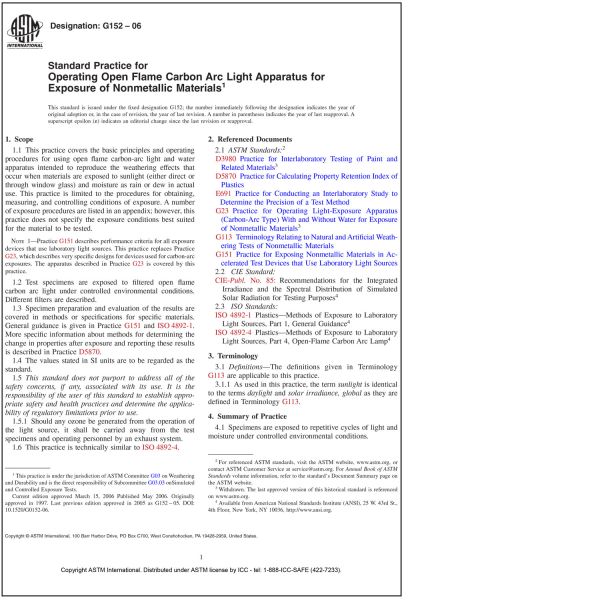
1.1 This practice covers the basic principles and operating procedures for using open flame carbon-arc light and water apparatus intended to reproduce the weathering effects that occur when materials are exposed to sunlight (either direct or through window glass) and moisture as rain or dew in actual use. This practice is limited to the procedures for obtaining, measuring, and controlling conditions of exposure. A number of exposure procedures are listed in an appendix; however, this practice does not specify the exposure conditions best suited for the material to be tested.Note 1Practice G 151 describes performance criteria for all exposure devices that use laboratory light sources. This practice replaces Practice G 23, which describes very specific designs for devices used for carbon-arc exposures. The apparatus described in Practice G 23 is covered by this practice.1.2 Test specimens are exposed to filtered open flame carbon arc light under controlled environmental conditions. Different filters are described.1.3 Specimen preparation and evaluation of the results are covered in methods or specifications for specific materials. General guidance is given in Practice G 151 and ISO 4892-1. More specific information about methods for determining the change in properties after exposure and reporting these results is described in Practice D 5870.1.4 The values stated in SI units are to be regarded as the standard.1.5 This standard does not purport to address all of the safety concerns, if any, associated with its use. It is the responsibility of the user of this standard to establish appropriate safety and health practices and determine the applicability of regulatory limitations prior to use.1.5.1 Should any ozone be generated from the operation of the light source, it shall be carried away from the test specimens and operating personnel by an exhaust system.1.6 This practice is technically similar to ISO 4892-4.
This standard is referenced in the 2012 International Building Code®.
| Description: | 1.1 This practice covers the basic principles and operating procedures for using open flame carbon-arc light and water apparatus intended to reproduce the weathering effects that occur when materials are exposed to sunlight (either direct or through window glass) and moisture as rain or dew in actual use. This practice is limited to the procedures for obtaining, measuring, and controlling conditions of exposure. A number of exposure procedures are listed in an appendix; however, this practice does not specify the exposure conditions best suited for the material to be tested.Note 1Practice G 151 describes performance criteria for all exposure devices that use laboratory light sources. This practice replaces Practice G 23, which describes very specific designs for devices used for carbon-arc exposures. The apparatus described in Practice G 23 is covered by this practice.1.2 Test specimens are exposed to filtered open flame carbon arc light under controlled environmental conditions. Different filters are described.1.3 Specimen preparation and evaluation of the results are covered in methods or specifications for specific materials. General guidance is given in Practice G 151 and ISO 4892-1. More specific information about methods for determining the change in properties after exposure and reporting these results is described in Practice D 5870.1.4 The values stated in SI units are to be regarded as the standard.1.5 This standard does not purport to address all of the safety concerns, if any, associated with its use. It is the responsibility of the user of this standard to establish appropriate safety and health practices and determine the applicability of regulatory limitations prior to use.1.5.1 Should any ozone be generated from the operation of the light source, it shall be carried away from the test specimens and operating personnel by an exhaust system.1.6 This practice is technically similar to ISO 4892-4. This standard is referenced in the 2012 International Building Code®. |
|---|---|
| Pages | 9 |
| Code Year | 2012 |
| Publisher | ASTM International |
| Language | English |